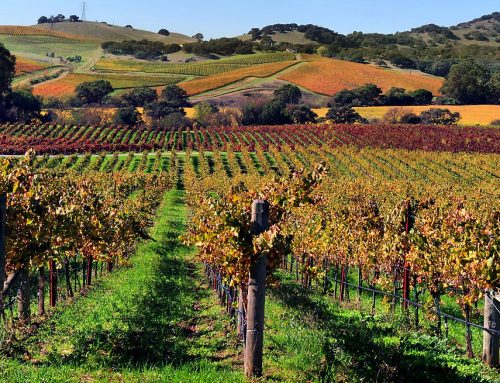
Washington is the great surprise of American wine — the nation’s second-largest wine producer, made not in a mild green valley but in a high, sun-baked desert east of the Cascade Mountains. Few people picture the Pacific Northwest as wine country, yet on the same latitude as Bordeaux and Burgundy, watered by great rivers and shaped by Ice Age floods, Washington makes powerful, balanced reds and crisp whites at prices that shame far more famous regions. This is the history of Washington wine.
Washington wine at a glance
- Where: Mostly the high desert of eastern Washington, east of the Cascade Mountains
- Scale: The second-largest wine-producing state in the U.S., after California
- Latitude: Around 46°N — the same band as Bordeaux and Burgundy
- Signature grapes: Cabernet Sauvignon, Merlot, Syrah, and Riesling
- Great AVAs: Columbia Valley, Yakima Valley, Walla Walla, Red Mountain, Horse Heaven Hills
- Key dates: 1967 Chateau Ste. Michelle · 1983 Yakima Valley AVA (the state’s first)
Wine in the desert
Washington’s wine country defies expectations. West of the Cascades lies the rainy, evergreen Seattle most people picture; but the vineyards lie to the east, in the rain shadow of those mountains, where annual rainfall can be as little as six to twelve inches — a genuine high desert.1 Here the vine survives only through irrigation, drawn from the mighty Columbia River and its tributaries, which turns arid sagebrush land into green rows of vines.
The payoff is a near-ideal growing climate. At roughly 46°N — the latitude of France’s greatest regions — Washington’s summer days are long and hot, with as much as sixteen or seventeen hours of sunlight, while clear desert nights turn sharply cold.1 That dramatic daily swing ripens the fruit fully while locking in acidity, giving Washington reds their characteristic balance of ripe flavour and firm structure.
The Ice Age foundation
Washington’s vineyards rest on land sculpted by one of the most violent geological events in North American history. Between roughly 15,000 and 13,000 years ago, the Missoula Floods — a series of cataclysmic Ice Age deluges — repeatedly tore across the region, stripping soil and depositing vast layers of sand, gravel, and wind-blown loess that form the vineyard soils of today.2
Those free-draining, sandy soils have a happy side effect: the phylloxera louse struggles to move through them, so most Washington vines are grown own-rooted — planted directly on their own roots rather than grafted onto American rootstock, as almost everywhere else in the world.2 It is a rare luxury, and a small badge of Washington’s distinctiveness — though it comes paired with a real hazard: the occasional brutal winter freeze that can damage or kill vines, a constant risk growers must manage.
From Riesling to reds: the modern industry
Washington’s modern wine industry is remarkably young. Its roots reach to 1934, when growers formed American Wine Growers just after Repeal, but the real beginning came in 1967 with the launch of Chateau Ste. Michelle, the state’s founding winery, which built its early reputation on Riesling and other whites.3 Crucially, the legendary California winemaker André Tchelistcheff was an early believer, lending his expertise and declaring Washington’s potential real.
For a time Washington was known mainly for its whites — and it remains one of the largest Riesling producers in the country.3 But growers soon realised that the sunny desert could ripen serious red grapes too, and the state’s ambitions turned toward Cabernet Sauvignon, Merlot, and Syrah. The stage was set for a red-wine revolution, and it would come from a small town in the state’s south-eastern corner.
Walla Walla and the red-wine revolution
The town of Walla Walla became the crucible of fine Washington red. Beginning in the late 1970s, a pioneering generation of small, quality-obsessed wineries — Leonetti Cellar (1977), Quilceda Creek (1979), Woodward Canyon (1981), and L’Ecole Nº 41 (1983) — began making powerful, age-worthy Bordeaux-style reds that drew national attention.4
Their success proved that Washington could make world-class red wine, and it inspired a wave of new producers. Sites like Red Mountain, a scorching, wind-swept slope famed for its intense Cabernet, and the broad Horse Heaven Hills became sought-after names.4 In the space of a generation, Washington went from a Riesling curiosity to a serious source of collectible red wine.
The appellations
Washington’s vineyards are organised under a nested family of appellations. Overarching almost all of them is the vast Columbia Valley, a huge AVA that sprawls across much of eastern Washington (and into Oregon) and contains the great majority of the state’s vines.5 Within it sit the more specific regions that give Washington wine its character.
The Yakima Valley, designated in 1983, was the state’s first AVA and remains a heartland of both reds and whites; Walla Walla is the prestige address for Bordeaux blends and Syrah; and tiny Red Mountain produces some of America’s most concentrated Cabernet.5 Across these regions, Cabernet Sauvignon leads the reds, with Merlot and fast-rising Syrah close behind, and Riesling and Chardonnay the principal whites — a compact but formidable roster.
Washington today
Today Washington stands as a quiet giant — second only to California in production, with over a thousand wineries, yet still offering some of the best quality-to-price in the wine world.6 Its reds routinely earn high critical scores and reward a decade or two of cellaring, often at a fraction of the price of comparable wines from more famous regions.
The state’s story is still being written. Growers continue to map its desert terroirs, push into cooler and higher sites, and manage the ever-present threat of winter cold. But the essential discovery has been made: that a high desert on the latitude of Bordeaux, watered by Ice Age rivers and grown on its own roots, can make wine to rival the world. Washington is proof that great American wine is not California’s story alone.
The character of Washington wine
Washington’s wines have a signature all their own, born of that desert paradox of scorching days and frigid nights. The reds are ripe and richly fruited yet firmly structured, with a fresh acidity and a savoury, mineral edge that keeps their power in check — a middle path, in a sense, between the lush opulence of California and the leaner restraint of Europe.6 Cabernet and Merlot show dark berry and graphite; the fast-rising Syrah can be strikingly wild and peppery; and the Rieslings run from crisp and dry to gently sweet.
That balance makes them exceptional food wines, at home with grilled and roasted meats, planked salmon, and the produce of the Pacific Northwest. Combined with prices that remain remarkably fair for the quality, it is a formula that has won Washington a devoted following — and helps explain why so many in the trade regard it as one of the best-value fine-wine sources anywhere in the world.
Keep exploring American wine
- Oregon & the Willamette Valley — the Pinot Noir country just to the south.
- New York & the Finger Lakes — America’s other great cool-climate Riesling region.
- American Wine: The Complete History — the national story Washington belongs to.
↑ Back to the American Wine flagship
See also: Oregon · Napa Valley
Bring a piece of wine history home
We’re building a shop of vintage-style wine-region maps and prints — including the Columbia Valley and its appellations. Visit the shop →
Frequently asked questions
Read more
To go deeper, these books make excellent companions:


As an Amazon Associate, This Day in Wine History earns from qualifying purchases. These are affiliate links; it costs you nothing extra and helps fund our research.
References & further reading
- Paul Gregutt, Washington Wines and Wineries: The Essential Guide, 2nd ed. (University of California Press, 2010), on the state’s climate, geography, and irrigation. ↩
- Kevin R. Pogue and others on the geology of the Columbia Valley and the Missoula Floods; Jancis Robinson & Julia Harding (eds.), The Oxford Companion to Wine, 4th ed. (Oxford University Press, 2015), s.v. “Washington” and “rootstocks.” ↩
- Paul Gregutt, Washington Wines and Wineries (UC Press, 2010), on American Wine Growers, Chateau Ste. Michelle, and André Tchelistcheff’s early role. ↩
- Washington State Wine Commission historical records on Leonetti Cellar, Quilceda Creek, Woodward Canyon, and L’Ecole Nº 41; Paul Gregutt, Washington Wines and Wineries. ↩
- U.S. Alcohol and Tobacco Tax and Trade Bureau (TTB), AVA regulations, including the Yakima Valley AVA (1983) and Columbia Valley AVA; Hugh Johnson & Jancis Robinson, The World Atlas of Wine, 8th ed. (2019). ↩
- Jancis Robinson & Julia Harding (eds.), The Oxford Companion to Wine, s.v. “Washington”; Washington State Wine Commission production statistics. ↩
Share This Story, Choose Your Platform!
Related Posts