

A small number of vineyards never had to be grafted. Their vines still grow on their own roots, exactly as European vines did before 1863 — and some of them are very old indeed.
When phylloxera swept through the world’s vineyards, survival came down to soil and geography. Where the insect could not travel, the vines were never grafted onto American rootstock. These “own-rooted” or “pre-phylloxera” vineyards are living relics — and among the most sought-after wines in the world.
Why sand and ash defeat the insect
Phylloxera moves through soil to reach roots, and it needs structure to do it. In loose sand the galleries it depends on collapse; the larvae cannot tunnel or establish stable feeding sites. Soils that are essentially clay-free — deep beach sand, or volcanic pumice and ash — have therefore been historically spared, whatever is planted in them. “Spared” is the honest word rather than “immune”: sandy Walla Walla in Washington was long assumed safe until an outbreak was confirmed there in 2019.12
Geography does the same job at a different scale. An ocean, a desert or a mountain range stops the insect arriving at all, provided quarantine keeps human beings from carrying it in on plant material or equipment.3
Santorini: vines older than the crisis
Santorini is the most remarkable case. Its vineyards sit on aspa — volcanic ash and pumice with almost no clay, laid down by the Bronze Age eruption — and phylloxera has never gained a foothold. The island holds the world’s largest concentration of ungrafted Assyrtiko, with average vine age across the appellation above 70 years — and root systems in some parcels estimated well past 200.24
The vines are trained into kouloura, a basket woven at ground level that shields the fruit from ferocious wind and traps scarce moisture. The technique also explains the extraordinary root ages claimed here: when a basket’s yield falls after 70-odd years, growers cut it back near the soil and let a new shoot rise from the surviving rootstock. The visible plant is renewed; the root system continues. Local growers argue some of those roots are many centuries old.4
The basket above ground is replaced every few generations. The roots beneath it may have been growing since before phylloxera existed as a problem.
Colares: vines in the dunes
On the Atlantic coast near Sintra, Colares grows Ramisco in deep beach sand — ungrafted, because nothing else is possible or necessary there. The appellation codifies it: vines must be planted in sand, and the practice of digging down through the dunes to plant is part of the region’s identity.56
Colares is also a cautionary tale. The vineyard survived the insect but not the property market: from roughly 2,500 acres in the 1940s it has shrunk to a fraction of that as Lisbon’s suburbs advanced — a decline of roughly 98%.5 Phylloxera-proof did not mean future-proof.
Chile: a country the insect never entered
Chile is walled off — Atacama Desert to the north, Pacific to the west, Andes to the east, ice to the south — and combined with import controls that isolation has kept it essentially phylloxera-free. Most Chilean vines still grow on their own roots, though some newer plantings are grafted for nematode resistance.37
That produced one of wine’s best stories. Chilean growers imported Bordeaux cuttings in the mid-19th century, just before the blight. Among the vines they believed to be Merlot was something else: Carménère, a Bordeaux variety largely abandoned in France after the blight — it grafts poorly onto American rootstock, and ripens late and unevenly. The confusion lasted more than a century until the French ampelographer Jean-Michel Boursiquot identified it in 1994, confirmed by DNA work at Montpellier. A grape written off in its homeland had been quietly surviving, ungrafted, on the other side of the world — and is now Chile’s signature.78
Australia’s ancestor vines
South Australia, Western Australia and Tasmania have never had phylloxera, protected by distance and by some of the strictest quarantine rules in the wine world.3 The Barossa consequently holds vineyards that predate the European catastrophe entirely: Langmeil’s Freedom vineyard, planted in 1843 by Christian Auricht, is widely believed to be the oldest surviving Shiraz planting anywhere.9
Since 2009 the Barossa Old Vine Charter has formalised what “old” means, grading vines in four tiers — Old Vine 35+, Survivor 70+, Centenarian 100+, and Ancestor Vines at 125 years or more — a framework designed to make these plantings worth preserving rather than replanting.910
| 1843Langmeil’s Freedom Shiraz, Barossa | 200+ yrsoldest Assyrtiko root systems | 1994Carménère identified in Chile |
Do own-rooted vines taste different?
This is where enthusiasm outruns evidence. Own-rooted wines are often described as purer or more transparent, and the claim is plausible — but almost every comparison is confounded. Ungrafted vineyards tend also to be old vineyards, on distinctive soils, farmed carefully at low yields. Vine age, site, and cropping level all move flavour, and they travel together with root type. Controlled rootstock trials, where those variables are held steady, tend to find the grape variety and the vintage dominate, with rootstock a comparatively minor influence.11
What can be said cleanly is that these vineyards preserve genetic material and viticultural practice that vanished elsewhere — and that a bottle from them is a direct taste of the pre-phylloxera world. That is reason enough to seek them out.
- Own-rooted / ungrafted = growing on its own roots, never grafted to American rootstock
- Survival comes from sand, volcanic ash (both clay-free) or geographic isolation
- Santorini: ungrafted Assyrtiko, kouloura baskets, root systems estimated 200+ years
- Colares: Ramisco in Atlantic dunes — survived phylloxera, shrank under suburbia
- Chile: effectively phylloxera-free; Carménère identified there in 1994
- Barossa: Langmeil’s Freedom Shiraz (1843); Old Vine Charter since 2009
Read more
- Phylloxera: how one insect nearly ended wine
- Why almost every wine grape grows on American roots
- When phylloxera came back: California’s AXR#1 disaster
- Wine regions of the world
References
- WineWiki, “Own-Rooted / Ungrafted Vines.” ↩
- WineWiki, “Pre-Phylloxera Ungrafted Vines: Santorini, Colares.” ↩
- Vinehealth Australia (phylloxera zones and quarantine); Phylloxera — Chile’s isolation (corroborated). ↩
- 67 Pall Mall, “Sea, sun & wine — the vines of Santorini” (vine ages, kouloura, rootstock renewal). ↩
- Colares DOC — sand planting, Ramisco, and the collapse in vineyard area (corroborated). ↩
- Wine-Searcher, “Colares” region profile. ↩
- VinePair, “Chilean Grapes Are Purer Than Any Others; Here’s Why.” ↩
- Carménère — Boursiquot’s 1994 identification and the Montpellier DNA confirmation (corroborated); Wine Enthusiast, “Rediscovering Chilean Carménère.” ↩
- Langmeil Winery, “Vineyards” (The Freedom 1843 Shiraz). ↩
- Barossa Australia, “Old Vine Charter” (introduced 2009; Ancestor Vines 125+ years). ↩
- Review literature on rootstock and sensory perception; SevenFifty Daily on own-rooted comparisons (confounding by vine age, site and yield). ↩
 Wine Grapes Robinson, Harding & Vouillamoz | 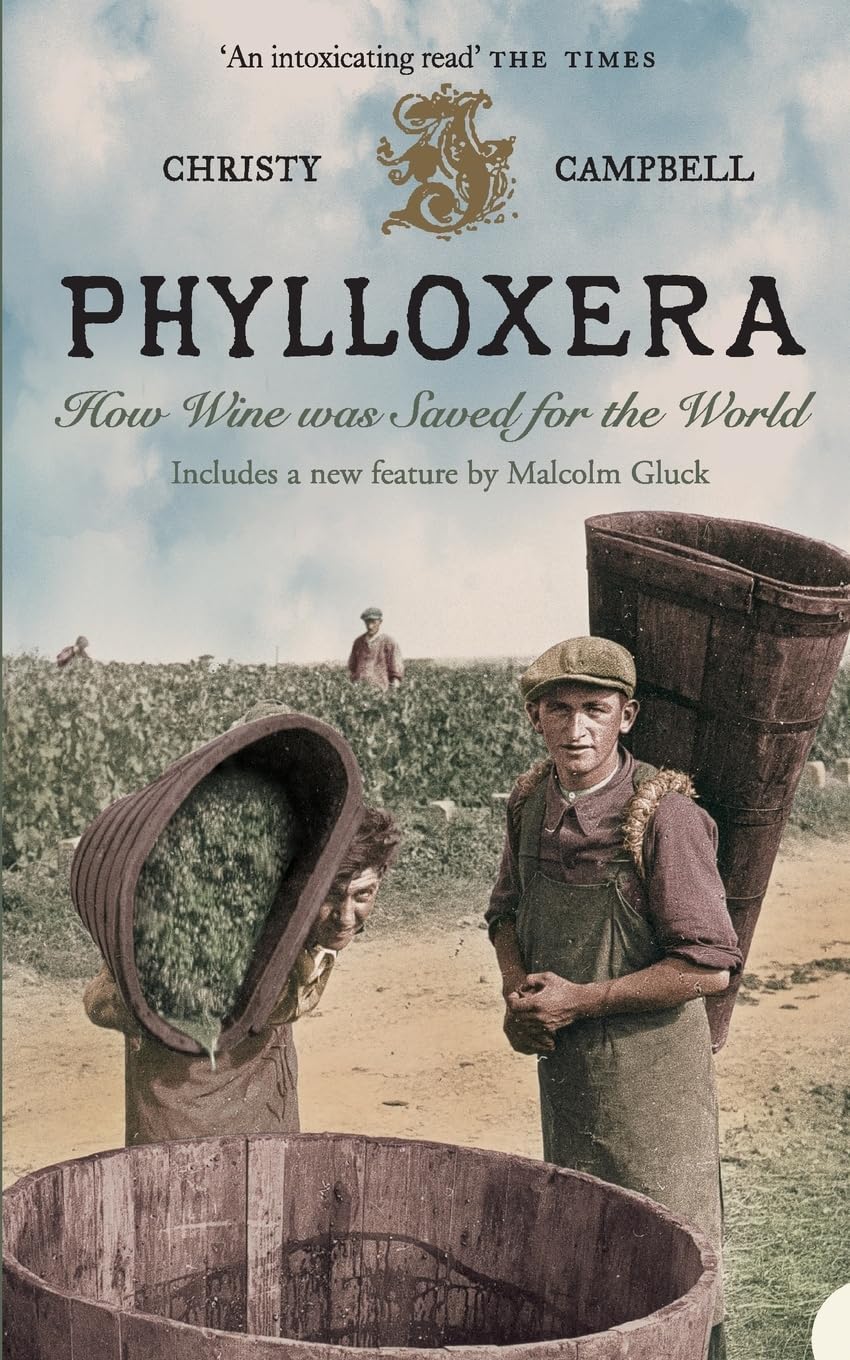 Phylloxera Christy Campbell |  The Oxford Companion to Wine Jancis Robinson (ed.) |
As an Amazon Associate, This Day in Wine History earns from qualifying purchases. Some links on this page are affiliate links.
Every day of the year has a wine story. Find today’s.
Share This Story, Choose Your Platform!
Related Posts


