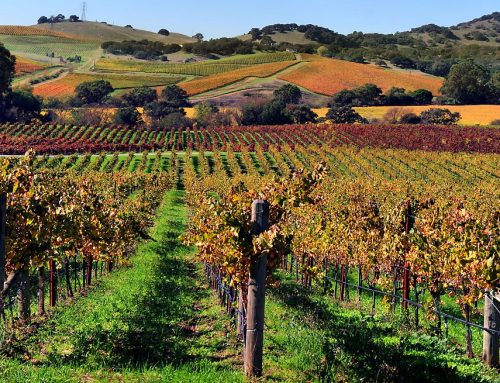
Nero d’Avola is the great red grape of Sicily — the island’s most planted dark variety and the wine that, more than any other, carried Sicilian red from anonymous bulk blend to bottled pride. Its name means simply “the black of Avola,” after a small town in the island’s sun-scorched southeast, yet for most of its history the grape travelled the world without a name at all, hidden inside other regions’ wines. This is the story of how Sicily’s workhorse became its flagship.
Nero d’Avola at a glance
- What: Sicily’s leading indigenous red grape variety
- Name: “Black of Avola” — after the town of Avola, near Syracuse
- Old synonym: Calabrese (a Sicilian dialect name, not a reference to Calabria)
- Style: Full-bodied, dark-fruited reds; plum, black cherry, liquorice, warm spice
- Signature wine: Cerasuolo di Vittoria DOCG — Sicily’s only DOCG — blended with Frappato
- First recorded: 1696, by the Sicilian botanist Francesco Cupani
The black grape of Avola
The grape takes its name from Avola, a coastal town in the province of Syracuse in southeastern Sicily, paired with the Italian nero, “black,” for its deeply pigmented skins.1 Its older and once more common name, Calabrese, has misled drinkers for centuries: it sounds as though the vine came from Calabria on the Italian mainland, but scholars now agree it is an Italianisation of the Sicilian dialect term Calaurisi — “the grape from Avola.” The vine is Sicilian to its roots.
Its documented history reaches back to 1696, when the Sicilian botanist and monk Francesco Cupani recorded the variety (as Calavrisi) in his catalogue of the island’s plants.1 For a grape that would spend the next three centuries largely uncelebrated, it is a surprisingly early entry into the written record — proof that Nero d’Avola has been central to Sicilian agriculture far longer than its recent fame suggests.
The workhorse of the wine lake
For most of the nineteenth and twentieth centuries, Nero d’Avola was valued not for what it was but for what it could do to other wines. Sicily was one of the largest wine producers in the Mediterranean, and its warm south poured out oceans of deeply coloured, high-alcohol red.2 Much of it never saw a Sicilian label. Instead it was loaded onto ships and sent north — to Piedmont, Tuscany, and even southern France — where it was used as vino da taglio, “cutting wine,” blended in to add colour, body, and strength to paler, thinner reds made in cooler climates.
It was anonymous, hard labour for a noble grape. Nero d’Avola built its muscles in that era — the sun, the drought-hardy old bush vines, the sheer concentration — but it earned no glory. As late as the 1980s, Sicily was still a byword for bulk, and its greatest red grape was known to almost no one who actually drank it.
The grape that came in from the cold
The turnaround came in the 1980s and 90s, when a new generation decided Sicily’s future lay in quality, not quantity. Estates such as Tasca d’Almerita, Planeta, Donnafugata, and Morgante began bottling Nero d’Avola on its own, treating it as a variety worth naming on the label rather than a cheap corrective to hide in a blend.3 With lower yields, cleaner cellars, and careful oak, the grape revealed a depth and generosity that surprised the wine world — ripe plum and black cherry, liquorice and Mediterranean herb, often compared to a sunnier cousin of Syrah or Zinfandel.
Within a couple of decades Nero d’Avola had gone from invisible to ubiquitous, appearing on wine lists from London to New York as the friendly, full-bodied face of the new Sicily. It became the commercial engine of the island’s revival, the wine that paid for the more experimental work happening on Etna and Pantelleria.
Cerasuolo di Vittoria: Sicily’s only DOCG
Nero d’Avola’s most prestigious role is played in the island’s far southeast, around the town of Vittoria, where it is blended with the lighter, perfumed Frappato to make Cerasuolo di Vittoria. In 2005 this wine was granted Denominazione di Origine Controllata e Garantita status — making it the one and only DOCG in all of Sicily, the top rank in Italian wine law.4
The blend is a study in balance: Nero d’Avola supplies the colour, structure, and dark fruit, while Frappato lifts it with red-berry fragrance and a lighter, almost dancing texture. The result — its name comes from cerasa, cherry — is one of Italy’s most distinctive and food-friendly reds, and living proof that Sicily’s workhorse grape can wear a crown.
A tale of two Sicilies in a glass
Part of Nero d’Avola’s appeal is that it is not one wine but many. Grown in the hot, dry vineyards of the west and centre, around Menfi and Agrigento, it makes powerful, jammy, high-alcohol reds built for richness.5 Grown in the cooler southeast, near Noto and Vittoria, where sea breezes and calcareous soils temper the sun, it turns fresher and more elegant, with brighter acidity and finer tannins.
That range is exactly why growers and drinkers have embraced it. Nero d’Avola can be an inexpensive, crowd-pleasing everyday red or a serious, terroir-driven wine of real finesse — sometimes from vines only a few miles apart. Three centuries after Cupani first wrote its name, the black grape of Avola has finally been allowed to show everything it can do.
Almost lost to fashion
Nero d’Avola’s revival was far from inevitable. In the 1980s and 1990s, as the wine world fell in love with a handful of international grapes, ambitious Sicilian producers faced enormous pressure to plant Chardonnay, Cabernet Sauvignon, and Merlot — the “safe” varieties that sold everywhere — and to treat their own natives as relics of a poorer past.3 For a moment it seemed the island’s indigenous heritage might be uprooted in the rush to look modern.
What saved Nero d’Avola was the broader movement to rediscover Italy’s native grapes, championed by writers, researchers, and a new breed of grower who realised that Sicily’s future lay in what made it different, not in copying Bordeaux or Burgundy. Estates began bottling old-vine Nero d’Avola as a badge of identity, and critics rewarded them. The grape that had nearly been discarded became, within a generation, the very symbol of Sicilian wine — a reminder of how close a great variety can come to vanishing before the world learns to value it.
Old vines and a warming world
Some of the finest Nero d’Avola still comes from old, low-yielding bush vines trained in the traditional Sicilian alberello (“little tree”) style — free-standing, close to the ground, and superbly adapted to drought and fierce sun.3 These gnarled survivors of the interior, in the rolling hills behind Agrigento and Caltanissetta, give wines of a concentration that young trellised vineyards struggle to match, and growers who once ripped such vines out are now guarding them as treasures.
That same toughness is giving the grape an unexpected future far from home. As vineyards around the world confront hotter, drier summers, winemakers have started looking to Mediterranean varieties bred for heat — and Nero d’Avola, which thrives where thinner-skinned grapes wilt, has begun to appear in warm corners of Australia and California. A grape that spent centuries as Sicily’s anonymous labourer may yet become a template for wine in a warming climate: proof, once again, that the island’s oldest workhorse still has new tricks to teach.
Keep exploring Sicilian wine
- Sicilian Wine: The Complete History — the island story that Nero d’Avola anchors.
- Italian Wine: The Complete History — the full national picture.
- Wine and the Risorgimento — how Sicily’s wine ties into the making of modern Italy.
↑ Back to the Sicilian Wine hub
See also: Italian Wine flagship
Bring a piece of wine history home
We’re building a shop of vintage-style wine-region maps and prints — including the sun-baked corners of Sicily. Visit the shop →
Frequently asked questions
Read more
To go deeper, these books make excellent companions:


As an Amazon Associate, This Day in Wine History earns from qualifying purchases. These are affiliate links; it costs you nothing extra and helps fund our research.
References & further reading
- Jancis Robinson & Julia Harding (eds.), The Oxford Companion to Wine, 4th ed. (Oxford University Press, 2015), s.v. “Nero d’Avola” and “Sicily”; Francesco Cupani, Hortus Catholicus (1696), first written record of the variety. ↩
- Nicolas Belfrage MW, Brunello to Zibibbo: The Wines of Tuscany, Central and Southern Italy, 2nd ed. (Mitchell Beazley, 2003), on the Sicilian bulk-wine and vino da taglio trade. ↩
- Ian D’Agata, Native Wine Grapes of Italy (University of California Press, 2014), the entry on Nero d’Avola and its modern revival. ↩
- Consorzio / Italian Ministry of Agriculture (MASAF), disciplinare di produzione for Cerasuolo di Vittoria DOCG (elevated to DOCG in 2005). ↩
- Jancis Robinson, Julia Harding & José Vouillamoz, Wine Grapes (Allen Lane / Ecco, 2012), entry on Nero d’Avola (Calabrese) and Frappato. ↩
Share This Story, Choose Your Platform!
Related Posts