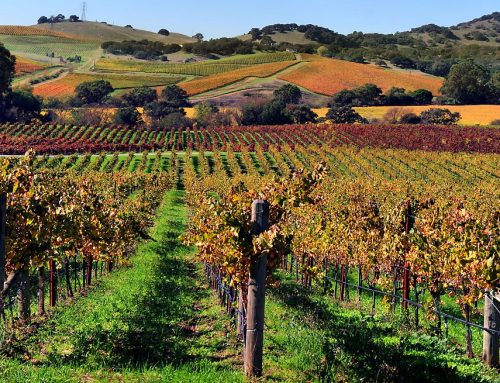
Loire Valley wine is the most diverse in France — the country’s longest wine list, strung for hundreds of miles along its longest river. In a single region you can drink bone-dry Sauvignon Blanc that smells of struck flint, honeyed Chenin that ages for a century, crisp Muscadet pulled from beside the Atlantic, and light, silky Cabernet Franc from the châteaux country where French kings once held court. This is the full story of the Loire: the garden of France, and the cradle of some of its most versatile wine.

Where: Across central and western France, following the Loire river from near the Atlantic at Nantes inland toward Sancerre — the “Garden of France”
Whites: Chenin Blanc (Vouvray, Savennières), Sauvignon Blanc (Sancerre, Pouilly-Fumé), Melon de Bourgogne (Muscadet)
Reds: Cabernet Franc (Chinon, Bourgueil, Saumur), with some Pinot Noir and Gamay
Styles: the full range — bone-dry to lusciously sweet to sparkling — making it France’s most stylistically varied region
Dates that matter: 1429 (Joan of Arc at Chinon) • 15th–16th c. (the royal court on the Loire) • 1709 (the Great Frost remakes Muscadet)
France’s longest wine list
The Loire is less a single wine region than four strung along one river. Out west, beside the Atlantic at Nantes, is Muscadet, all sea-breeze and salt. Upstream lies Anjou-Saumur, home to Chenin Blanc and sparkling wine. Then comes Touraine — Vouvray, Chinon, Bourgueil — the heart of château country. And far inland, on the river’s upper bend, sit Sancerre and Pouilly-Fumé, the spiritual home of Sauvignon Blanc. No other French region spreads so wide or makes so many different kinds of wine; the only thing they truly share is the river that ties them together.1
The garden of kings
For a golden century, the Loire was the centre of France. From the 1400s the kings and their courts built their fairy-tale châteaux — Chambord, Chenonceau, Amboise — along the river, and the wine of the Loire became the wine of the crown. Its history runs even deeper than its architecture: in 1429 it was at the fortress of Chinon that a teenage Joan of Arc picked the disguised Dauphin out of a crowded hall and set France on the road to victory in the Hundred Years’ War.2 A generation later the great satirist François Rabelais, born near Chinon, filled his novels with joyful praise of the local red — making Loire wine perhaps the first in France to be immortalised in literature.3
Chenin Blanc, the shape-shifter
If one grape captures the Loire’s range, it is Chenin Blanc. From the same variety, Loire growers make bone-dry whites, gently off-dry ones, sparkling wines, and some of the longest-lived sweet wines on earth — nectars from botrytis-shrivelled grapes at Quarts de Chaume and Bonnezeaux that can outlive the people who bottle them. The secret partly lies underground: the soft white limestone of the region, tuffeau, was quarried to build the châteaux, and the resulting caves now make perfect cellars, cool and damp, for ageing Vouvray for decades.4
Cabernet Franc, the Loire’s red
The Loire’s serious red is Cabernet Franc — the same grape that quietly parents Bordeaux, but here given the leading role. In Chinon, Bourgueil and Saumur-Champigny it makes lithe, aromatic reds full of red fruit, violets and a signature note often described as pencil shavings or fresh earth. Cool and graceful rather than powerful, it is the antidote to the heavyweight reds of the south — and increasingly fashionable for exactly that reason.5
Muscadet, the Dutch, and the Great Frost of 1709
The Loire’s crispest wine owes its existence to a disaster. In the 1600s Dutch traders dominated the wine business at the mouth of the Loire, buying vast quantities of thin local white to distil and to ship north. Then came the terrible winter of 1709, one of the coldest in European history, which froze the vineyards around Nantes to death. When growers replanted, they chose a hardy, frost-resistant grape brought from Burgundy — Melon de Bourgogne — and from it made a pale, briny, thirst-quenching wine: Muscadet. Aged on its spent yeast (sur lie) for extra texture, it became the classic partner to the Atlantic oysters landed a few miles away — a great wine born of a hard frost and a foreign trade.6
Sancerre, gunflint, and the world’s Sauvignon Blanc
At the Loire’s far inland end, the twin hills of Sancerre and Pouilly-Fumé became the reference point for Sauvignon Blanc — the taut, green, mineral style that growers everywhere from New Zealand to Chile now chase. The magic is in the ground: seams of flint (silex) give the wine its famous smoky, struck-match edge, the pierre à fusil or “gunflint” note that gave Pouilly-Fumé (“smoked”) its name. There is a twist of history here, too: before phylloxera, Sancerre was mainly a red-wine district planted to Pinot Noir. Only when the louse forced a total replanting did it switch to Sauvignon Blanc — and stumble into becoming the most imitated white-wine village on earth. It pairs, famously, with the local Crottin de Chavignol goat cheese, grown on the very same hills.7
The Loire’s second life: biodynamics and natural wine
In the last few decades the Loire has reinvented itself once more — as the beating heart of France’s natural and biodynamic wine movement. At Savennières, the eccentric visionary Nicolas Joly turned his Coulée de Serrant into one of the world’s most famous biodynamic estates and spent his life preaching the gospel of farming by the moon. Around him, especially in Touraine and Anjou, gathered a generation of low-intervention growers whose cloudy, characterful wines helped launch a global movement. The old garden of kings became, improbably, the laboratory of wine’s future.8
Saumur bubbles and the pink that conquered the table
Two more Loire styles deserve their due. Around Saumur, the same chalky tuffeau caves that age Chenin also hold millions of bottles of traditional-method sparkling wine; Crémant de Loire and sparkling Saumur are among the finest French fizz made outside Champagne, by exactly the same method. And in the twentieth century the Loire gave the world one of its great commercial successes: Rosé d’Anjou, the gently sweet, salmon-pink wine that became a fixture on mid-century tables across Britain and America and, for a whole generation, was many drinkers’ very first taste of French wine. Serious and simple, ancient and modern — the Loire has always refused to be just one thing.9
Every Loire story on This Day in Wine History
Go deeper on the grapes and the history of France’s most varied region:
- Chenin Blanc: the Loire’s shape-shifting white
- Cabernet Franc: the Loire’s graceful red
- The Loire Valley and its wine industry
- Pinot Noir: the grape that once ruled Sancerre
A map of the region for your wall, or a new wine-history story in your inbox every week.
Frequently asked questions
Read more
To go deeper, these books make excellent companions:


As an Amazon Associate, This Day in Wine History earns from qualifying purchases. These are affiliate links; it costs you nothing extra and helps fund our research.
Sources & further reading
- Rod Phillips, French Wine: A History (Oakland: University of California Press, 2016) — on the diversity and history of the Loire. University of California Press. ↩
- “Joan of Arc,” Encyclopædia Britannica — on the 1429 meeting with the Dauphin at Chinon. britannica.com. ↩
- Jancis Robinson & Julia Harding, eds., The Oxford Companion to Wine, 4th ed. (Oxford: Oxford University Press, 2015), s.v. “Loire” — including Rabelais and the region’s literary history. Oxford Reference. ↩
- The Oxford Companion to Wine, 4th ed. (OUP, 2015), s.v. “Chenin Blanc,” “Vouvray” and “tuffeau.” ↩
- The Oxford Companion to Wine, 4th ed. (OUP, 2015), s.v. “Cabernet Franc” and “Chinon.” ↩
- Phillips, French Wine: A History (UC Press, 2016), and The Oxford Companion to Wine, 4th ed. (OUP, 2015), s.v. “Muscadet” and “Melon de Bourgogne” — on the Dutch trade and the 1709 frost. ↩
- The Oxford Companion to Wine, 4th ed. (OUP, 2015), s.v. “Sancerre” and “Pouilly-Fumé” — on flint soils and the post-phylloxera switch to Sauvignon Blanc. ↩
- The Oxford Companion to Wine, 4th ed. (OUP, 2015), s.v. “natural wine,” “biodynamic viticulture” and “Savennières.” ↩
- The Oxford Companion to Wine, 4th ed. (OUP, 2015), s.v. “Crémant de Loire,” “Saumur” and “rosé d’Anjou.” ↩
Share This Story, Choose Your Platform!
Related Posts